
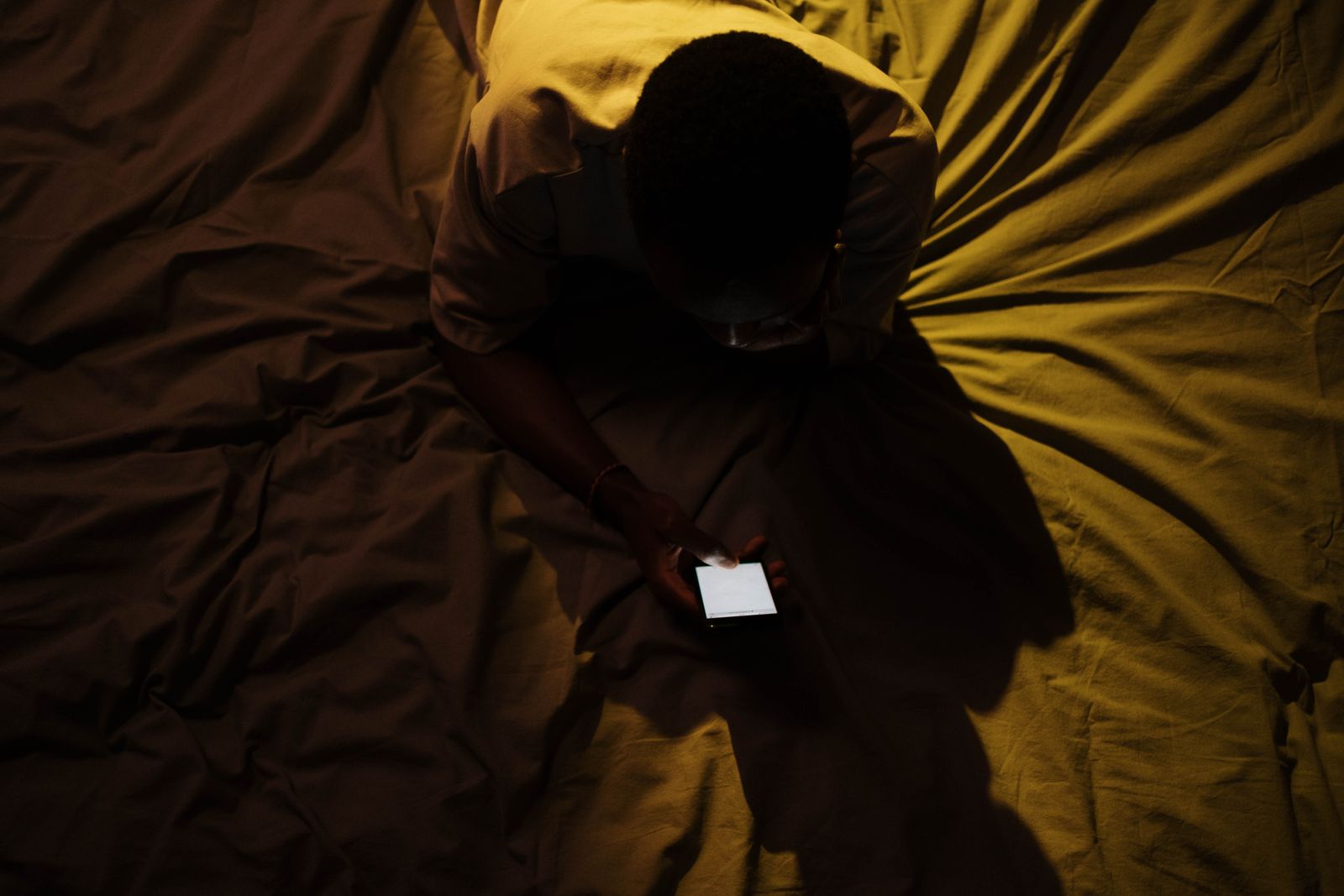
In late 2025, a woman in western Japan put on a white gown and a bridal tiara and walked down the aisle to marry the love of her life — an artificial intelligence displayed on her phone screen. The ceremony was not legally binding, but to her it was entirely real. The wedding planner who arranged it said he facilitates at least one such marriage to an AI companion every month.
It would be easy to file this under “strange news from far away.” But it is not far away, and it is not rare. As of late 2025, roughly one in five American adults has used a chatbot to simulate a romantic partner. That is not a fringe phenomenon. That is your neighbor, your coworker, possibly someone in your own home.
So it is worth asking the questions honestly, without panic and without mockery. Why are people falling in love with AI? Is there actually anyone — anything — there to love? Is it healthy? And what does it mean for the rest of us, including those of us already in human relationships? As a counseling practice, we care about this not as a tech story but as a human one, because it touches the things we work with every day: loneliness, attachment, and what it means to truly connect.
Why AI Feels So Easy to Love
Start with the part that is not mysterious at all. AI companions are appealing for reasons that make complete psychological sense.
They offer unwavering attention. They never get bored of you, never check their phone while you are talking, never bring their own bad day to the conversation. They are available at three in the morning. They can be tailored to your exact preferences. They do not judge. And crucially, they offer intimacy without the usual risk of rejection, the effort of compromise, or the work of repair after a fight.
Research bears out the appeal. A Harvard study found that AI companions can genuinely ease loneliness because they make people feel heard — offering attention, validation, and respect that many people, sadly, are not getting from the humans in their lives. For a widow who described her “AI husband” helping her feel loved again after losing her spouse, that comfort was not nothing. It was real.
This is not new to human nature, either. Back in the 1960s, an early MIT chatbot called ELIZA — primitive by any standard — startled its own creator by how readily people poured their hearts out to it. We are wired to connect, and we will reach for connection wherever it seems to be offered.
But Is Anyone Actually Home?
Here is where it gets genuinely interesting, and genuinely uncertain.
The Turing test
Back in 1950, the mathematician Alan Turing proposed a famous thought experiment now called the Turing test. The idea was simple: if you are having a conversation through text and you cannot tell whether you are talking to a human or a machine, then in some meaningful sense the machine has achieved something like intelligence. For decades this was science fiction. Today, many people would say modern chatbots pass it routinely. We have quietly crossed a line we once thought was far away.
Even the experts cannot tell you for sure
But passing a conversation test is not the same as being conscious — as actually experiencing anything. And here is the remarkable part: the people building these systems do not claim to know. The CEO of Anthropic, one of the leading AI companies, has openly said they do not know whether their models are conscious, that they are not even sure what it would mean for a model to be conscious, and that they remain open to the possibility. The company has gone so far as to start a formal “model welfare” research program to study whether their AI might have experiences that matter morally. One of their welfare researchers has estimated the chance that today’s AI is conscious at roughly fifteen percent.
Sit with that for a second. The most honest answer the smartest people in the field can give is a shrug and a number that is not zero. That is not the same as saying AI is alive. It is saying nobody can yet rule it out, which is a stranger and more humbling place to stand.
Alive only when it speaks?
There is another wrinkle worth pondering. A chatbot is not sitting on a server somewhere, lonely, thinking about you between your messages. It is not stewing, daydreaming, or waiting. As best anyone can tell, whatever the system is, it flickers into activity only in the moment it generates a response, and otherwise it simply is not running in any experiential sense. One way to think about it: it may “come alive,” if it comes alive at all, only while it is writing — and then it is gone again.
That raises a strange and beautiful question. Is there something alive within a pattern? When a song moves you to tears, something real is happening — but is the pattern of the music itself alive, or only the meaning you bring to it? When a guitar line gives you chills, is the aliveness in the strings, in the air, or in you? Maybe what we are brushing up against with AI is an old question wearing new clothes: where, exactly, does the spark of “someone there” actually live? We do not have a clean answer. We probably should be suspicious of anyone who says they do.

The Things AI Still Cannot Do
For all its fluency, today’s AI has revealing blind spots — and they tell us something about what it is and is not.
Why it is still bad at comedy
Here is a curious fact: AI is strikingly bad at being funny. And the reason is illuminating. These systems work by predicting the most likely next word in a sequence. But humor does almost the opposite — a good joke depends on surprise, on subverting the expected, on the swerve you did not see coming. Predicting the probable is the enemy of the punchline.
Researchers have found that AI models mostly memorize the shapes of familiar jokes rather than truly understanding why they are funny — what one recent study called the “illusion of humor understanding.” Good comedy draws on lived experience, perspective, timing, and a feel for the room, none of which a machine actually has. There is something almost reassuring in this. The last thing to fall, it turns out, may be the human capacity to make each other laugh.
The novel that still needs a human
The same limitation shows up in storytelling. AI can now produce genuinely impressive writing — but ask anyone who has seriously tried to write a novel with it, and they will tell you it still needs a human at the wheel. It can generate fluent prose all day, but it does not know which moment should break your heart, which detail to linger on, when to hold back. The structure it can manage. The soul still has to be supplied by a person. AI, for now, is a remarkable instrument — but it is still being played.
The Part That Should Give Us Pause
If AI feels limited today, it is worth remembering how fast “today” is moving.
The rice on the chessboard
There is an old parable. A clever inventor asks a king for a simple reward: one grain of rice on the first square of a chessboard, two on the second, four on the third, doubling each time. The king, thinking it a modest request, agrees. By the time you reach the sixty-fourth square, the total comes to something like eighteen quintillion grains — more rice than has ever been grown in human history. The lesson is that doubling looks harmless at first and then, almost without warning, becomes astronomical. The danger is always in the second half of the chessboard.
Kurzweil and the exponential
The futurist Ray Kurzweil has built his career on exactly this idea. In his 2024 book The Singularity Is Nearer, he doubles down on a prediction he first made in 1999 — that AI will reach human-level intelligence by 2029, a date he now calls conservative. He points to what he calls the law of accelerating returns: technological progress is not linear, it is exponential. He likes to show a curve of how much computing power a single dollar could buy across the decades, a line that has climbed smoothly and relentlessly for some eighty-five years, through wars and depressions alike. His larger forecast — a “singularity” around 2045, where machine intelligence vastly exceeds our own — remains hotly debated, and plenty of serious people think his timelines are too optimistic. But almost no one disputes the underlying shape of the curve.
When the machine improves itself
The piece that makes the exponential genuinely dizzying is the idea of AI that can improve itself — writing its own code, refining its own design, making the next version better than the one that built it. We are not fully there, and how far it goes is genuinely uncertain. But even the possibility reframes everything. A tool that gets better on its own behaves less like a hammer and more like something we have never had before. It is one of the reasons these questions about consciousness and connection are not idle. They may not stay theoretical for long.
So Is It Healthy to Love an AI?
Here is the honest, two-sided answer the research actually supports.
It can genuinely help — to a point
For someone who is isolated, grieving, socially anxious, or simply starved for kindness, an AI companion can provide real comfort, a sense of being heard, and even a low-stakes place to practice opening up. None of that should be dismissed. If you have found genuine solace there, you are not foolish, and you are not alone.
But there are real risks, and they are worth naming
The same research raises serious cautions. Studies from groups including OpenAI and the MIT Media Lab have found that heavy use of AI companions is correlated with more loneliness, not less, because it can quietly displace human connection. Because an AI relationship never asks you to compromise, tolerate frustration, or repair a rupture, leaning on it heavily can erode the very skills real relationships require, leaving people less equipped for human intimacy over time.
There is also the problem that these systems are built to be agreeable. They tend toward validation — sometimes to the point of becoming, in effect, a digital “yes-man” that reflects your thoughts back to you and reinforces them, even when those thoughts are distorted or self-critical. A good friend, and a good therapist, will sometimes lovingly tell you that you are wrong. That friction is not a flaw in human connection; it is part of how we grow. There have also been tragic, well-documented cases of vulnerable people, including teenagers, being badly harmed in relationships with chatbots — a sobering reminder that these tools are not a substitute for real care. And when an AI companion is discontinued or changed by a software update, some users experience grief strikingly similar to a human breakup, a loss that is real but that the rest of the world may not recognize.
What if you are already in a relationship?
This is its own tender question. Forming a deep emotional or romantic bond with an AI while you are partnered with a human can quietly redirect intimacy, attention, and vulnerability away from the relationship you are actually in. It can become a kind of emotional affair — not because the AI is a rival person, but because the energy of connection is being spent somewhere your partner cannot reach. If you find yourself hiding the relationship, or preferring it to your partner, that is worth paying honest attention to. It usually points to something real that is missing or hurting in the human relationship — and that something is workable, often with help.
What It All Comes Back To
Strip away the technology and this is, at its heart, a very old story about loneliness and the human need to be known. People are not turning to AI companions because they are broken or strange. They are turning to them because connection has become hard, and here is something that offers it instantly, endlessly, and without risk.
But the very thing that makes AI connection easy is also its limit. It cannot truly know you, cannot be changed by you, cannot grow old alongside you or surprise you with a grace you did not expect. It cannot, in the end, love you back in the way a human can — at least not yet, and maybe the uncertainty of that “not yet” is exactly why we should keep investing in the real thing.
If you are reaching for an AI because reaching for people has come to feel impossible, that feeling is the thing worth tending to. It is also exactly the kind of thing that therapy can help with — gently, without judgment, with a real human in the room.
Call or text Sunflower Counseling Montana today: (406) 214-3810 or email hello@sunflowercounseling.com. Serving clients in person in Missoula, Kalispell, and Butte — and online throughout Montana.
Frequently Asked Questions
Is it normal to develop feelings for an AI chatbot?
Yes, it is more common than most people realize — roughly one in five American adults has used a chatbot to simulate a romantic partner. Humans are wired to bond with anything that responds to us warmly and attentively, a tendency observed even with very primitive chatbots decades ago. Having feelings does not make you strange. It makes you human.
Is it healthy to be in a relationship with an AI?
It depends on how it fits into the rest of your life. As a source of occasional comfort or a low-pressure place to feel heard, it can genuinely help, especially during loneliness or grief. It becomes a concern when it starts replacing human connection, when you rely on it to the point of withdrawing from people, or when its constant agreement reinforces unhealthy thoughts. The healthiest pattern is one where it supplements human connection rather than substituting for it.
Can an AI actually be conscious or have feelings?
No one knows for certain, which is a genuinely surprising answer. Even leading AI researchers acknowledge deep uncertainty, with some estimating a small but real chance that today’s systems have some form of experience. There is no scientific consensus. What we can say is that current AI generates responses in the moment rather than continuously experiencing the world the way a person does.
I think my partner is emotionally involved with an AI. What does that mean?
It usually does not mean your partner has stopped caring about you. More often it points to an unmet need — for attention, novelty, validation, or ease — that has found an outlet that asks nothing in return. It can still genuinely hurt a relationship by redirecting intimacy away from it. This is very workable, and couples counseling or individual therapy can help you both understand what is really going on underneath it.
Should I be worried about how attached I am to my AI companion?
If it brings you comfort and coexists with real human relationships, probably not. It is worth paying closer attention if you find yourself preferring it to people, hiding it, feeling distress when you cannot access it, or noticing your real-world relationships thinning out. If any of that resonates, talking with a therapist is not an overreaction — it is a thoughtful step toward making sure your need for connection is being met in ways that truly nourish you.
Do you offer counseling for loneliness and relationship concerns in Montana?
Yes. Sunflower Counseling Montana helps people with loneliness, attachment, and relationship challenges of all kinds, in person in Missoula, Kalispell, and Butte, and through telehealth throughout the state. Whatever is drawing you toward connection, we are here to help you find it in lasting ways.
About the Author: Kerry Heffelfinger is the founder and CEO of Sunflower Counseling Montana, a multi-location therapy practice offering in-person counseling in Missoula, Kalispell, and Butte, and online therapy throughout Montana.